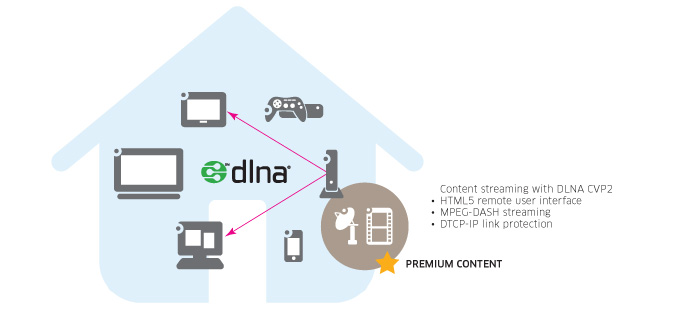
Consumers want to watch premium content on every connected device in the home. To maintain their supremacy in the home, pay TV operators need the ability to quickly make their video services available on every new device that reaches the market.
By capitalizing on Digital Living Network Alliance (DLNA) standards, including the new Commercial Video Profile 2 (CVP2) specification, operators can gain a fast and cost-effective means to reach more devices with premium content from the cloud.
New screens bring new opportunities
Today’s fast broadband networks make it possible to stream video to consumers on demand in the home. This increased speed has enabled new online video streaming services — Apple, Netflix, Amazon/LoveFilm, Hulu and others — to capture a share of the home entertainment market. It has also inspired broadcasters to extend their offers to devices beyond the TV, as seen with TV Everywhere in the US and YouView and SkyGo in the UK.
Not to be outdone, pay TV operators are exploring IP Video as the next way to deliver TV services to the home. With IP video, operators can use the network to deliver premium content directly to a broad range of consumer-purchased devices. Network-based delivery will remove the need for in-home digital video recorders (DVRs) set-top boxes (STBs) and complex home gateways, which currently cost operators billions of dollars each year.
New screens also bring fragmentation
Device fragmentation presents a formidable obstacle to aspiring multiscreen pay TV operators. These operators need to meet the demand for premium content across a fast-growing and increasingly diverse collection of devices, including smart TVs, tablets, smartphones, PCs and game consoles. To provide a captivating multiscreen experience, pay TV operators need to deliver on expectations in three key areas:
- Content discovery and control: Deliver interfaces that make it easy for users to find, select, record and consume content across a variety of screens. Smartphone and tablet applications can provide these functions, but they need the ability to recognize and interact with other devices in the home.
Content streaming: Ensure that all in-home devices can support content streamed as unicast IP traffic. Adapt formats and bit rates to different devices and available bandwidth.
- Content protection: Authenticate subscribers using IP addresses, username/password credentials or device information. Scramble streamed content using per-session encryption keys or a full DRM scheme. Restrict sharing to the home network.
Two factors raise the degree of difficulty for operators. One is the lack of similarity between smart TV operating systems. The other is the concurrent use of many variants of the Android operating system. To deliver a superior IP video experience to every subscriber on every screen, an operator must support hundreds of combinations of devices and operating systems.
DLNA offers solutions to the multiscreen challenge
The DLNA CVP2 specification offers solutions to the device fragmentation challenge. It provides a quick and cost-effective means for pay TV operators to extend whole-home DVR and multi-room services across many devices. Moreover, it can empower operators to use their networks to stream premium content to subscriber-owned devices on demand.
By capitalizing on DLNA standards, including the new Commercial Video Profile 2 specification, operators can gain a fast and cost-effective means to reach more devices with premium content from the cloud.
DLNA specifications focus on ensuring interoperability between certified wired and wireless devices. They eliminate the need for operators to develop clients for specific functions like device interoperation and control. The CVP2 specification adds capabilities like auto-discovery, HTML5 support, client security, content encoding and adaptive streaming. Pay TV operators can use these capabilities to quickly develop universal clients that reduce the complexity and cost involved in extending their services throughout the connected home.
Device interaction and content discovery
DLNA allows devices on the home network to seamlessly find each other, discover each other’s capabilities and interact. For example, a TV or game console can get and stream content by connecting to a network-attached storage device or PC acting as a media server. Or, a smartphone or tablet can act as a remote control that helps users discover content on a media server and play it on a TV.
Enhanced user interfaces and HTML5 support
Connected consumers expect consistent and compelling user interfaces (UIs). DLNA is addressing these expectations by building HTML5 support into the CVP2 specification. The addition of HTML5 will enable operators to create remote UIs that take advantage of the web browsing capabilities and superior processing power offered by the current generation of connected devices.
By using web-based HTML5 UIs, operators can extend a consistent user experience across a broad range of devices. There is no need to develop a separate application for each device/OS combination. HTML5 web pages download the user experience to the client device. If required, operators can make quick updates to the look and feel of these pages and make them available to all devices at once.
Content streaming through MPEG-DASH
Most CE devices purchased today include built-in support for HTTP Adaptive Streaming (HAS) technologies that can adapt the streaming bit rate to the available bandwidth.
With HAS, content is encoded into multiple bit rates. Clients dynamically pull the bit rate that is best suited to current network conditions. DLNA supports Dynamic Adaptive Streaming over HTTP (MPEG-DASH), a standardized form of HAS. It also supports other forms of HAS, including Microsoft Smooth Streaming and Apple Live Streaming.
Cloud-based content sourcing
Pay TV operators’ current DLNA implementations rely on home gateways that act as media servers. A gateway receives content from the operator’s network, processes it as needed and delivers it to other devices in the home. This approach is a logical choice for MSOs that run television services over QAM networks and require QAM tuning by way of a device in the home.
Home gateway-based media servers make little sense for telcos that run pure IP networks, or for MSOs that are migrating to all-IP networks. These operators can reduce costs by migrating key media server capabilities and processing functions – content preparation, transcoding, recording, UI rendering and device-specific packaging – to the network.
Migration may be a gradual process for cable operators, with clients rendering unified UIs from media server sources both in the home (high usage linear QAM-based video channels) and from the network. Over time, sources will migrate from the home to the network and reduce reliance on home gateways and STBs.
Content protection
DLNA specifies that Digital Content Protection over IP (DTCP-IP) be used for moving content between devices. DTCP-IP allows any pair of devices to establish a secure link with no input from a digital rights management (DRM) system. To restrict content sharing to the home environment, DTCP-IP imposes localization rules that govern time to live, round trip time and concurrent source streams.
These rules exist because DTCP-IP security is weaker than most DRM schemes. It is adequate for in-home sharing of media between DLNA-compliant devices. But an MSO or IPTV operator knows that it is delivering to a subscriber on its network. It is therefore logical for the operator to treat DLNA sources as extensions of the home network and work with TV studios and the Digital Transmission Licensing Administrator (DTLA) to relax these localization rules. Relaxed rules would allow the operator to stream directly from its network to devices in subscribers’ homes.
By capitalizing on DLNA standards, including the new Commercial Video Profile 2 specification, operators can gain a fast and cost-effective means to reach more devices with premium content from the cloud.
Shaping the future of pay TV
The DLNA CVP2 specification will enable cable and IPTV operators to quickly and cost-effectively extend cloud-based streaming TV services to multiple devices in subscribers’ homes. By allowing operators to migrate processing functions to the network, it will help create a simpler connected home that is free of set-top boxes. Operators that take advantage of CVP2 will deliver pay TV services directly to subscribers and avoid having to ship hardware to their homes.

Source: https://techzine.alcatel-lucent.com